


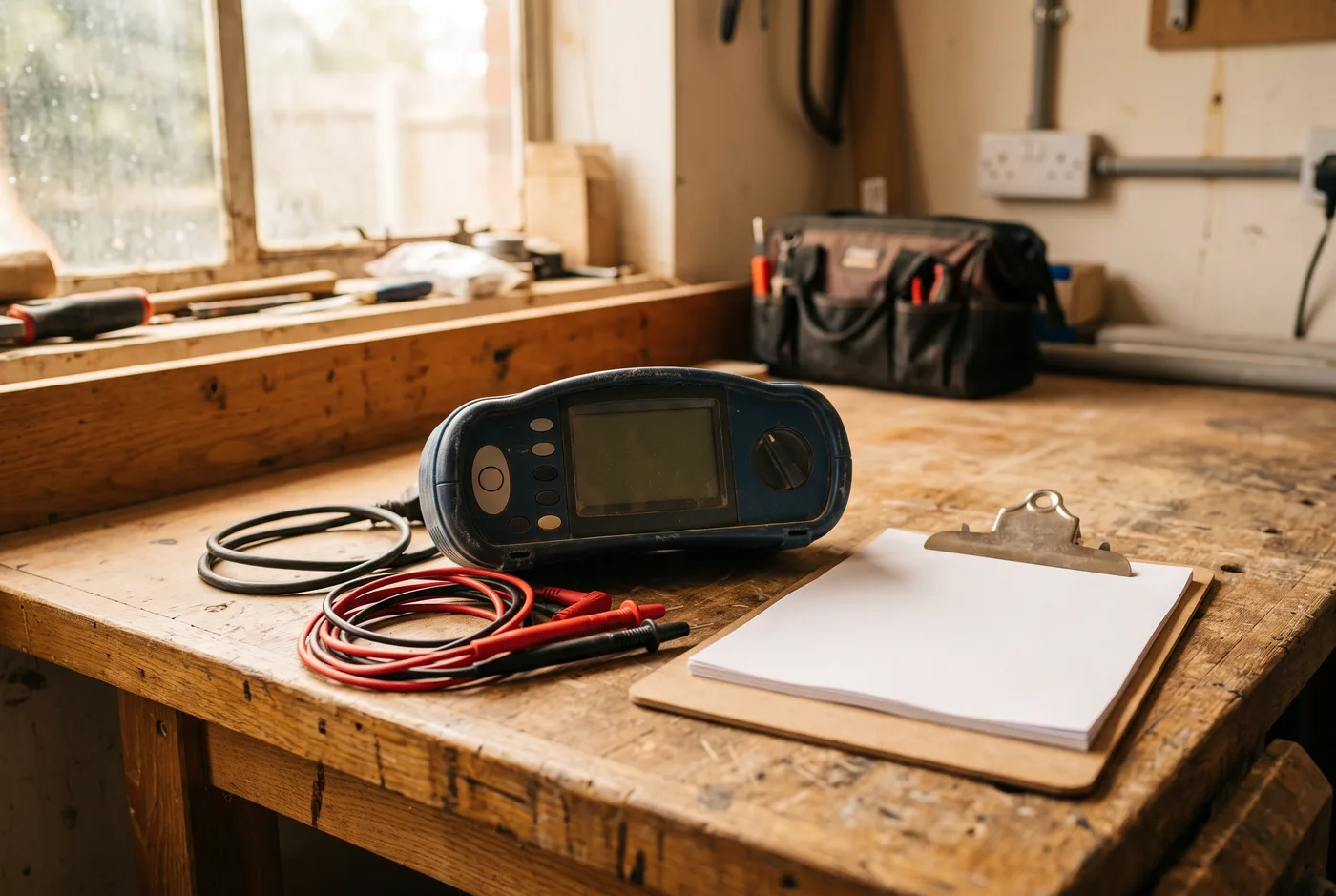
Electrical Testing and EICRs in Sheffield
IE Electricals carries out electrical testing and EICRs across Sheffield and surrounding areas, inspecting the fixed wiring in rented and owner occupied properties and reporting the condition found, in line with BS 7671. To book an EICR or ask about electrical testing, call IE Electricals on 07427 293958.
An Electrical Installation Condition Report, an EICR, is a health check of the fixed wiring in a property. IE Electricals inspects and tests the wiring, the consumer unit, sockets and fixed connections across Sheffield and surrounding areas, then reports the condition found in plain terms.
An EICR does not test portable appliances or extension leads. It looks at what is fixed in the property, the wiring behind the walls, the consumer unit and the sockets and switches it feeds, so you know whether the installation is safe to remain in use.
Landlords, owner occupiers and businesses all have reason to get one done, though the reasons and the intervals differ. Whichever applies to you, the visit, the testing and the report you receive follow the same process, explained below, so you know what to expect before booking a visit.
Who needs an EICR and how often
How often an EICR is needed depends on the type of property. Rented homes in England have a legal minimum interval, owner occupied homes follow general safety guidance, and commercial premises typically follow common industry practice. A shorter interval applies if the inspecting engineer recommends one, regardless of the property type.
The table below sets out the general position for each property type. It is a starting point rather than a fixed rule for every property, since the condition of the existing installation can mean a shorter interval is sensible even where none is required by law.
| Property type | Recommended interval |
|---|---|
| Privately rented homes in England | At least every 5 years, under the Electrical Safety Standards in the Private Rented Sector (England) Regulations 2020 |
| Owner occupied homes | Every 10 years as general guidance, or at a change of occupancy such as buying or selling, whichever comes first |
| Commercial premises | Commonly every 5 years as general industry practice, though the correct interval depends on the type of premises and its use |
EICR intervals by property type
- Privately rented homes in England
- At least every 5 years, under the Electrical Safety Standards in the Private Rented Sector (England) Regulations 2020
- Owner occupied homes
- Every 10 years as general guidance, or at a change of occupancy such as buying or selling, whichever comes first
- Commercial premises
- Commonly every 5 years as general industry practice, though the correct interval depends on the type of premises and its use
| Code | Meaning |
|---|---|
| C1 | Danger present. An immediate risk of injury, made safe before the inspector leaves |
| C2 | Potentially dangerous. Not dangerous right now but could become so, for example a missing earth or damaged cable |
| C3 | Improvement recommended. Advisory only, with no legal obligation to act, and does not make the report unsatisfactory |
| FI | Further investigation required. Not a defect in itself, but means more investigation is needed before the report is complete |
EICR codes explained
- C1
- Danger present. An immediate risk of injury, made safe before the inspector leaves
- C2
- Potentially dangerous. Not dangerous right now but could become so, for example a missing earth or damaged cable
- C3
- Improvement recommended. Advisory only, with no legal obligation to act, and does not make the report unsatisfactory
- FI
- Further investigation required. Not a defect in itself, but means more investigation is needed before the report is complete
Which certificate do you need?
Answer the three questions and the matching document appears here.
What each certificate means
- Electrical Installation Condition Report (EICR)
- An EICR reports the condition of the fixed wiring in a property, with any faults coded. It confirms whether the installation is safe to remain in use or whether work is needed.
- Electrical Installation Certificate (EIC)
- An EIC is issued for new electrical installation work, such as a new circuit, a new consumer unit or a rewire. It confirms the work meets BS 7671 and is safe to use.
- Minor Electrical Installation Works Certificate
- A Minor Electrical Installation Works Certificate covers a small addition or alteration to an existing circuit, such as an extra socket. It cannot be used for a new circuit or consumer unit.
- Ask us which certificate applies
- If you are not sure which certificate applies, tell us what the work involves and we will confirm which one, if any, you need.
What happens during an EICR visit
The consumer unit and the wiring it protects are inspected and tested, along with a sample or full set of sockets, switches and fixed connections depending on the property. Power is switched off to the circuits being tested, so some disruption during the visit is normal.
Anything found during testing is recorded as it is found. You are talked through anything serious before the visit ends, rather than finding out only once the written report arrives. This gives you the chance to ask questions while the inspector is still on site.
How long the visit takes depends on the size of the property and the number of circuits, sockets and fixed connections involved. A small flat generally takes less time than a larger family home or a commercial unit with several distribution boards. Access matters too, since a property that has been altered or extended over the years can take longer to test thoroughly than one with a straightforward, unaltered layout.
What the report contains
The written report records the condition of the installation, lists any damage, deterioration or non compliance found, and gives each finding a code. The codes describe how serious a finding is, from advisory only through to something needing immediate attention, so you can see at a glance what matters most.
Alongside the findings, the report records details of the installation itself, such as the number of circuits tested and the type of consumer unit in place, giving a clear reference point for any future work or a future EICR to compare against.
The report also states the date the inspection was carried out and, where relevant, the recommended date for the next one. Keeping a copy alongside any previous reports builds a useful history of the property's wiring over time, particularly for a rented property that changes tenants regularly and needs a report to hand at each change.
Electrical testing and EICR inspection reports for rented and owner occupied properties.
Satisfactory versus unsatisfactory
An EICR is marked satisfactory if it has no codes, or only advisory C3 codes. It is marked unsatisfactory if it carries any C1, C2 or FI code, meaning remedial work or further investigation is needed before the installation can be confirmed safe to the current standard.
A C3 finding does not make a report unsatisfactory on its own. It is advisory, and there is no legal obligation to act on it immediately, though it is worth keeping in mind for future work. A C1 finding is treated differently: it means an immediate risk of injury, and the situation is made safe before the visit ends rather than left for a later date.
An FI finding sits apart from the others. It is not itself a fault, but it means something could not be fully assessed on the day, so further investigation is needed before the report can be finalised as satisfactory or unsatisfactory. This is explained clearly in the report, along with what the further investigation involves.
EICRs when buying, selling or letting a property
An EICR is often arranged around a specific event: a new tenancy starting, a sale going through, or a periodic check falling due. For a landlord, the report is provided to the tenant along with the tenancy paperwork. For a buyer or seller, it gives a clear, independent record of the wiring's condition at a specific point in time.
None of this changes what the inspection covers or how it is carried out. Whatever the reason behind the enquiry, the same wiring is inspected and tested, and the same reporting standard applies to the result, regardless of who has asked for the EICR or why.
What to send with an enquiry
The details below help scope your EICR accurately before a visit is arranged, and mean a written quote can be given without a second round of questions.
- The type of property (rented, owner occupied or commercial) and roughly how old it is
- Whether the EICR is for a new or existing tenancy, a sale or purchase, or a routine check
- Any previous EICR or test report, if you have one
- Photos of the consumer unit, if convenient
- The best way and time to reach you
Related services
Frequently asked questions
What is an EICR?
An EICR, an Electrical Installation Condition Report, is a report produced after the fixed wiring in a property is inspected and tested. It covers the wiring, the consumer unit, sockets and fixed connections, and records the condition found along with any faults, coded by how serious they are.
How much does an EICR cost?
Cost depends on the size of the property, the number of circuits, access to the wiring and whether it is a domestic or commercial installation. A written quote follows once these details are known, so the price reflects the property rather than a general figure.
How often do rented properties need an EICR?
Landlords letting a home in England have to keep the fixed wiring inspected and tested on a cycle of no more than 5 years. That duty comes from the 2020 private rented sector electrical safety regulations. A shorter gap applies where the engineer writing the report asks for one.
What happens during an EICR visit?
An inspector works through the consumer unit, the fixed wiring and a selection of sockets and connections, testing as they go. Circuits have to be isolated while that happens, so expect the supply to come and go through the visit. Anything serious is explained face to face, ahead of the written report.
What will I receive once testing is complete?
You receive a written EICR recording the condition of the installation, any codes found, and whether the report is satisfactory or unsatisfactory overall. This gives you a clear record of the wiring's condition at the time of the inspection, which is worth keeping for future reference.
Which areas do you cover for electrical testing?
IE Electricals covers Sheffield and surrounding areas, including districts across the city and nearby towns, for both domestic and commercial electrical testing. The same inspection and reporting process applies wherever the property is, so get in touch to confirm coverage for your address.
How do I book an EICR?
Send an enquiry with the type of property and why you need the EICR, or call IE Electricals on 07427 293958. A visit is arranged once the details are known, followed by a written quote for the work, so you know the cost before booking anything in.
Do I need a certificate as well as an EICR?
An EICR reports on the existing wiring, it is not the same as an Electrical Installation Certificate, which is issued for new work such as a new circuit or a rewire. If an EICR identifies remedial work, that work is certified separately once it is carried out and tested.
Is electrical testing itself notifiable work?
No, carrying out an EICR is inspection and testing, not new electrical work, so it is not notifiable under Part P on its own. If the EICR identifies remedial work such as a new circuit, that remedial work may be notifiable depending on what it involves.
What information should I send when booking an EICR?
Send the type of property, roughly how old it is, and the reason for the EICR, such as a new tenancy, a sale or a routine check. Any previous test report and photos of the consumer unit help, along with the best way to reach you, so a quote can follow.
Last updated:
Book an EICR or ask a question
Send an enquiry with details of your property, or call IE Electricals on 07427 293958 to discuss electrical testing.